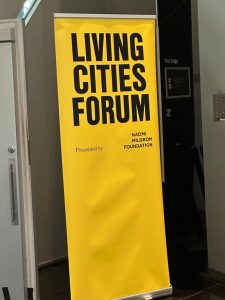
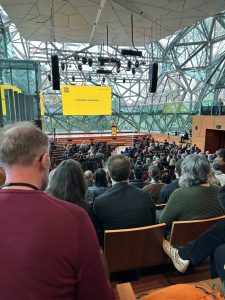
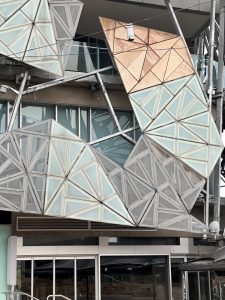
Yesterday, I lived like a 40-something. Scuttling puddles and robotic people, I made my way to Federation Square to attend a Conference called Living Cities, organized by the Naomi Milgrom Foundation. I was very excited to join the cool squad of architects, Futurists and urban designers exploring the future of our cities.
I woke at 4am too excited to sleep. Planned my smart, artsy and effortless wardrobe so I could engage in the pretense that this 77 year old goes to international conferences most days of her week, instead of curling up with the cat in bed by 9pm. I arrived early at the EDGE theatre and after 3 coffees and with a yellow Lanyard strung around my neck, I joined the in- crowd. It felt so good! Stylish deconstructed, black clothed people, a plethora of man-buns and chai lattes wandered into the auditorium.
Networking was rampant and conversations like ” Yes, just back from Copenhagen for a few days and then off to Berlin next week! ” But the one I overheard and liked most was,” We had a big off-site with the Directors yesterday which was excellent. We explored ideation, collaboration and insistent thinking.” I think that means they talked about ideas, working together and thoughts that just won’t go away. Like a chocolate craving!
But it wasn’t all posturing and preening. with a series of keynote speakers and workshops we explored questions like these…..
- How can we design cities that are more resilient, equitable, distinctive and meet diverse community needs?
- How can design quality be reframed from high end luxury for the few, competing with social and environmental housing goals?
- How do we design cities that care – about place, about people and about what kind of city we want to leave behind as a testament to this age in our history?
- How do we manage competing forces of a political agenda, the numbers game (how many houses, at what cost, in what timeframe), good planning, governance, good urban design and social equality and cohesion? (My Question)
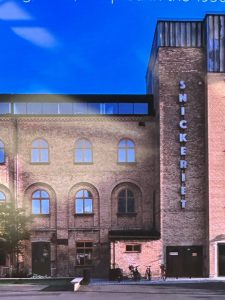
Two of the keynote addresses were exceptional. Finn Williams is the City Architect for the city of Malmo in Sweden since 2021 and he has also worked extensively in the UK. Malmo has a reputation for pushing boundaries and embracing change in urban design. He spoke about the Swedish concept of Omsorg, which is the idea that we are only temporary stewards of a city and we need to design a city with CARE in mind. Care in Malmo means bridging inequality of access to well designed housing and urban space. It means creating distinctive neighbourhood identity by consulting people who will live there.
Omsorg in this Swedish city also means building homes rather than houses. What does this mean? Houses are structures built to a formula. Homes create safety, nurturing, opportunities for engagement, places of kinship and care for families and individuals. Homes cluster in neighbourhoods with distinctive character, where people can have shelter, meet, play, learn and grow. The concept of Omsorg also means care for the future of the city and its past and what this will mean for future generations.
“In Malmo, they talk of homes rather than housing, single – occupancy units or dwellings.”
Malmo has become a poster child for successful renewal and a city that is safer, friendlier, cleaner and greener than most cities. It has 187 different nationalities living in the city and yes there are still ghettos of low cost housing. The focus in this city is on repurposing buildings rather than demolishing them, creating an urban forest and engaging with residents to redesign buildings and public space. He gave an interesting example of an old industrial area of the city that has been repurposed as the Noise Zone. In it you’ll find all the noisy stuff- night clubs alongside car mechanics, popular bars and clubs, small welding businesses, factories, all located in a non- residential, high noise area.
Buildings in Malmo are built to last and repurposing buildings rather than new construction is the norm. 80% of old warehouses have been kept and reshaped into offices and residential areas. There is also a massive Material Bank. Think a city owned Whelan the Wrecker yard the size of a data centre, which stores old beams, flooring, doors, trusses, windows i.e. building materials reclaimed from renovated old buildings that will be repurposed. However, Williams did say that this still only meets a quarter of the building materials needed in the city of Malmo.
Another speaker, Ludwig Engel hails from Berlin and is a Futurist and an activist in a policy lab called HouseEurope! I could get all clever with words here about how much I enjoyed his session, but instead…. He Was Simply Brilliant!
He talked about in the year 2000 when he facilitated scenario planning of what the future could look like. One group imagined a global financial crash. Another a climate disaster. The group assigned a global pandemic looked bored with this unlikely topic! Another group imagined individual tourist travel to the moon. Another group, robotics. Engel said that every scenario they imagined as fantastical had happened, except perhaps an alien invasion!
Engel talked about the ineffective practice of demolishing old buildings to create new, higher, larger buildings despite all the evidence showing renovation of existing buildings is a more sustainable and socially cohesive alternative. When building becomes an asset, Engel argues a city becomes a product. The focus on mass production of housing at lowest cost exists in some parts of Berlin. In other wealthier areas, developers demolish old homes to newly construct higher, larger buildings where investors purchase housing that is too expensive to live in, so it remains unoccupied for years, serving as a tax break.
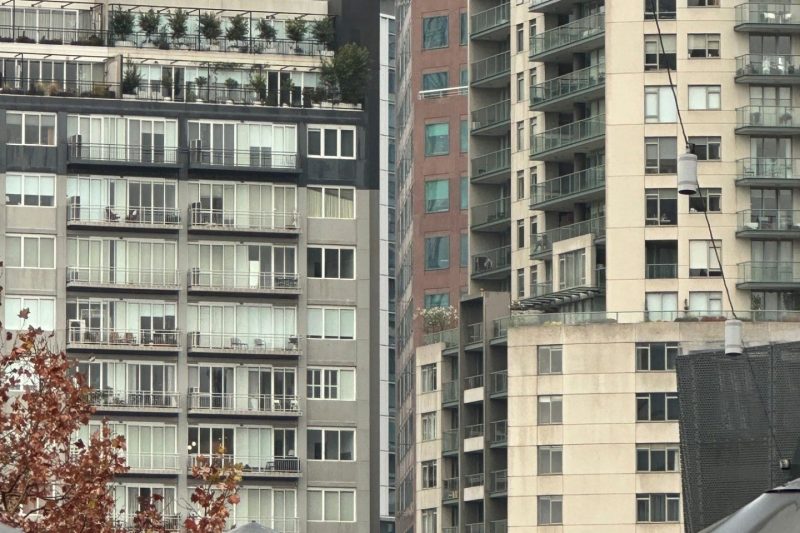
My thoughts flashed to Melbourne. The Flemington Towers, public housing, due to be demolished, the grass roots action by residents to save their homes and communities. I think of the grand old homes of Toorak that are demolished to make way for bigger gated enclosures for the rich and famous. I think of the empty penthouses in St Kilda Road and Southbank, bought by overseas investors, standing empty. These are issues on our doorstep, not only in Berlin.
Engel also talked about House Europe! This is a community driven non – profit that advocates for EU legislation to make renovation, adaption and re-use of existing buildings easier, cheaper and more socially equitable. He is working at the governance and policy level with members across Europe to bring about change. Such an inspiring presentation.
Each profession has their own language. Psychologists talk about family of origin, boundaries, trauma and attachment. Urban Designer – speak includes materiality, place-based architecture, civic equality, materials led architectural practice and recentering the human experience in the built environment. By the end of the day I was reasonably fluent in the language of urban design.
As I left the intensity of the conference, my brain whizzing like a half dead fly, I couldn’t help feeling that some language was barely heard in this meeting of minds and talent. Those words were cost, financing, return on investment- housing as capital. Housing as the focal point of elections to be won or lost. The practicalities of building mass housing to an equitable standard and fast. A future where housing translates the dreams of a generation for whom the dream of a first home is like that they’ve seen on The Block TV series…. a bland McMansion. Urban Designers seem blinkered by the world of AI and how this may impact future design and housing construction. IKEA houses must be on the horizon- built by robots perhaps?
How much does repurposing a building cost relative to new construction? How do we get developers to embrace Home-ing and all its implications rather than chasing big profits? The answer seemed to be through regulation and policy directives. While Malmo and the European initiatives are exciting they remain aspirational for most of the world, where pressure to house large numbers of people, fast, is the prevailing narrative.
This felt like a scenario I know very well. Urban designers, in their silo with their language (place- making, repurposing, sustainability) agree with each other about what future cities should look like. Developers with their own language of ROI, profit, and financing sit in their silo agreeing with each other. Government policy makers look at the next election date and in their silo, hear the boom of politicians telling them to make housing happen faster. My work over twenty years in change management, was about cracking open these silos, building a common focus and language and getting the agreed job done. It’s called Collaboration and here’s a situation begging for such an intervention..oh sorry….that’s Change Speak for get together, listen and work together!
While there were gaps in conversation at the conference, I have never felt so alive, engaged and inspired to tell everyone about the ideas that jumped around in my monkey brain. Wearily, I made it home to my cosy little flat, chatted to my neighbour, patted his dog, then sat in my soft armchair with a glass of wine in hand looking at my maximalist den of paintings, books, sculpture, colour, travel momentos, and family photos. I took a deep breath. My home.
Words and images by Nora Vitins
Marvellous, informative article, full of energy and Nor’s curiosity. I’m inspired to get out and broaden my horizons more, then take a day off for recovery.
Oh Di
I missed this beautiful comment! Thank you. Yes get out there! So much fun and I could hear my brain cells having a workout…. Nor x